
LevelUp Casino games, payments and mobile access
 Available in US
LevelUp Casino combines slots and live-dealer tables with card, e-wallet and cryptocurrency payment options. Its mobile web app and account controls add convenience, while the choice between fiat and crypto changes the financial risks of every transaction.
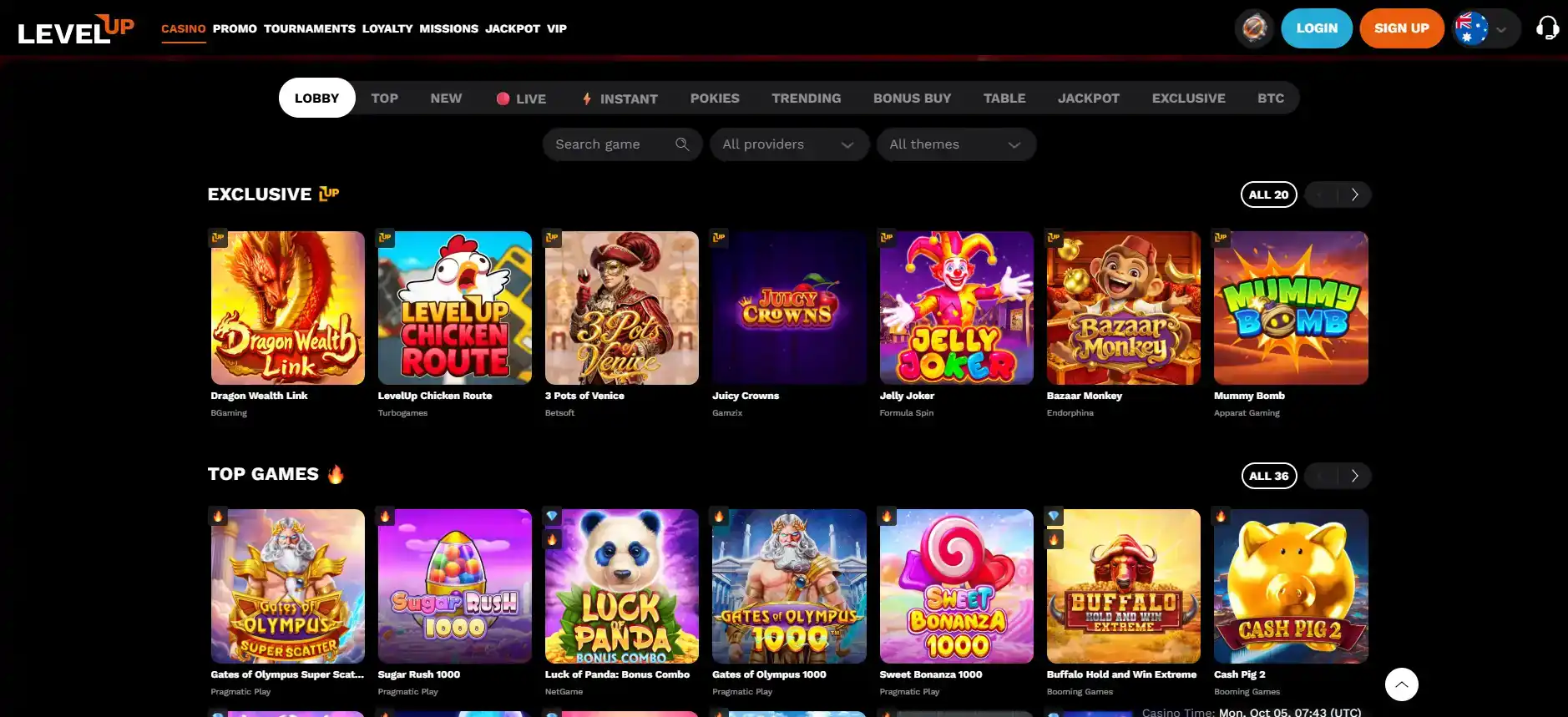
Launched in 2020, LevelUp Casino is a hybrid gambling platform with traditional payment channels, several listed cryptocurrencies, a large multi-studio game catalogue and dedicated loyalty features. Understanding its two payment rails and the practical differences between game types is more useful than treating every listed feature as an equivalent advantage.
Online casino services are prohibited in Australia, and ACMA has listed Level Up Casino among prohibited-service enforcement outcomes. Read the Australian access and licence details.
- Platform modelHybrid fiat and crypto
- Casino categoriesSlots and live-dealer games
- Listed cryptocurrenciesBTC, ETH, USDT, LTC and more
- Mobile formatBrowser play and downloadable web app
Table of Contents
- A web app links mobile play with account controls
- Slots and live tables drive a broad game library
- The hybrid model adds currency and session decisions
- VIP and loyalty features sit alongside location-based offers
- Deposit and loss limits support planned breaks
- Cash-out method matters as much as deposit currency
- What price moves and transfer fees do to a crypto deposit
- Ratings and complaint outcomes add practical context
- Common questions about the LevelUp product
- LevelUp combines a broad catalogue with two very different payment risks
A web app links mobile play with account controls
LevelUp provides mobile-browser access and a downloadable web app for iOS and Android. A web app behaves differently from a conventional native-store application: it is based on web technology and can provide a more app-like entry point without implying that a separate native package is offered. Both formats bring the game catalogue and account functions onto a smaller screen, where navigation and session awareness can change.
Account currency, verification and spending limits remain relevant regardless of the screen used. LevelUp’s registration experience includes a fiat-currency choice, with AUD available among the account currencies. The selected denomination affects how balances and cash-outs are read. It does not erase conversion costs when funds originate in a different currency or a cryptocurrency.
Browser access
A mobile browser opens a familiar web session. Shared devices, saved passwords and browser tabs deserve attention because account information can remain visible after a session ends. See the mobile web app and browser comparison for device-level considerations.
Account checkpoints
Identity documents may enter the withdrawal process, particularly around an initial cash-out or a new payment method. The account and verification section explains the connection between currency selection, player limits and support requests.
On any phone, confirmation screens deserve a deliberate second look. A small display can truncate a long payment address, compress a currency symbol or hide a selected network behind a dropdown. These are general mobile-payment risks that do not depend on the app’s visual design. A readable transaction record is useful when an account or payment question reaches live chat.
Slots and live tables drive a broad game library
Slots and live-dealer games form the core of LevelUp’s casino catalogue. Named studios include Evolution, Pragmatic Play, NetEnt, Nolimit City, Play’n GO, Playtech, Red Tiger, BGaming, Hacksaw Gaming and Relax Gaming. A broad supplier mix matters because game mechanics, volatility, limits and interface design belong to individual titles, not to the casino as a whole.

For a slot, return to player (RTP) is a long-run mathematical property of a particular game under specified rules. It is neither a promise for a session nor a universal number for a whole casino. Volatility answers a different question: how unevenly wins and losses may appear. Two games with similar theoretical RTP can expose a fixed session budget to very different swings.
Studio slots
Individual titles determine the paytable, volatility, bonus-round mechanics and bet range. Checking those properties avoids treating a provider name as a shortcut for risk.
Live-dealer tables
A hosted round follows the pace of the dealer and the game rules. Table stakes and decision time affect how rapidly a planned bankroll can be exposed.
Exclusive titles
The catalogue includes 18 exclusive games. That label describes how the titles are positioned in the library; each game’s own rules remain the place to check its mechanics and payout information.
Why a game count says little about session cost
A catalogue total combines very different products. Session cost is driven by stake size, number of rounds, each game’s theoretical edge and actual variance. A player making many small spins can expose more money than someone playing a handful of slower table rounds, even when both start with the same balance.
For a closer look at studios, live-dealer formats and the mechanics behind game selection, see LevelUp’s games and live tables. Keep game-specific paytables and house edges separate from site-wide marketing descriptions; an impressive catalogue is still a collection of separate mathematical products.
The hybrid model adds currency and session decisions
LevelUp’s hybrid payment setup connects familiar card and wallet transactions with assets whose value can change while held or transferred. A fiat account is easier to read when deposits, balances and withdrawals all share a currency. Cryptocurrency adds two moving parts: the asset’s exchange value and the rules of the blockchain carrying it. Both can affect the amount ultimately available after a transaction.
Traditional payment considerations
- Compare the funding currency with the account denomination.
- Check whether a wallet or bank adds its own conversion or intermediary charge.
- Keep the payment reference and any settlement confirmation together.
Cryptocurrency considerations
- Match the entire receiving network, not only the coin ticker.
- Allow for a change in coin value between sending and receiving.
- Recognise that a completed blockchain transfer is generally irreversible.
A chargeback mechanism, where available under a card issuer’s rules, and a cryptocurrency transfer are fundamentally different dispute processes. A card transaction passes through financial intermediaries; blockchain settlement typically relies on the address and network entered when the transfer was initiated. Mistyped details can make a crypto transfer unrecoverable. The presence of both payment families on one platform does not make their protections or settlement behaviour interchangeable.
When comparing methods, separate the amount leaving the original wallet or bank account from the balance credited in the chosen account currency. Conversion and network charges can sit between those two figures even where the casino adds no transaction fee.
Risk also accumulates during play. A balance that rises or falls with market prices can blur whether a change came from game results or from the cryptocurrency itself. A session budget denominated in a familiar reference currency keeps those two forms of exposure easier to understand.
VIP and loyalty features sit alongside location-based offers
LevelUp runs both VIP and loyalty programmes. Those labels indicate separate account features, but the practical value of any reward still depends on its individual conditions: whether it is cash or bonus balance, whether withdrawal restrictions attach to it and whether a spending or playthrough requirement is involved. A benefit tied to additional turnover can increase exposure even if its headline value looks generous.
Welcome offers vary by location. General descriptions of an offer therefore cannot be treated as a universal set of terms. A useful way to understand the mathematics of any wagering requirement is to compare the money credited with the total amount of wagering it would require, then consider the average cost of that extra play. A reward and an unrestricted cash balance are different financial objects.
For example, a hypothetical bonus with a wagering multiple would require repeated stakes before any eligible withdrawal. Each extra round introduces house-edge exposure and variance. This general principle applies regardless of the colour or presentation of a promotional banner. The existence of a loyalty programme likewise tells little about the eventual value of a reward without its underlying rules.
Deposit and loss limits support planned breaks
LevelUp includes deposit limits, wagering limits, loss limits, time-outs and self-exclusion among its responsible-play tools. These controls serve different purposes. A deposit limit bounds new money entering an account; a loss limit targets the amount lost over a set period; a wagering limit can constrain the total staked, including money that has been won and replayed. They are most useful when their differences are understood before a session.
- Choose a spending boundary. Decide what amount can be lost without affecting bills, savings or essentials, and keep that decision separate from a hoped-for win.
- Set a time boundary. A session can last longer than expected when short game rounds and mobile access remove natural pauses. A planned stopping point creates a reason to close the screen.
- Use a stronger interruption when needed. A cool-off or time-out is more substantial than a reminder; self-exclusion is designed for a longer break from access.
A wagering limit can be reached before a loss limit because the same balance can circulate through repeated stakes. Conversely, a volatile game may exhaust a loss allowance quickly in relatively few rounds. The controls complement one another instead of representing interchangeable settings.
How deposits, wagering and losses differ
Consider a purely illustrative A$100 session budget. Adding A$100 to an account is one deposit; staking A$5 twenty times is A$100 of wagering even if some stakes return winnings; the eventual loss is the difference between funds committed and funds remaining. These figures measure separate things and should never be added together as though they were three separate charges.
Player tools work alongside decisions away from the site, including turning off payment shortcuts and taking breaks. Support channels can help clarify where a limit or exclusion is managed; free Australian counselling is also linked in the footer for anyone who wants confidential help separate from a gambling operator.
Cash-out method matters as much as deposit currency
Cards, Skrill, Neteller, MiFinity, bank-style transfers and cryptocurrencies appear among LevelUp’s listed payment families. BTC, BCH, ETH, LTC, DOGE and USDT are listed among the cryptocurrency options, with XRP also appearing in the available payment catalogue. The actual combination depends on the account and payment context. AUD is among the listed account currencies, while euro-denominated amounts in third-party payment examples should not be interpreted as Australian cashier terms.
Payment channels differ in where their costs arise. An e-wallet may hold a balance in one currency while the casino account uses another; a bank transfer may involve intermediary charges; crypto can involve both an exchange-rate spread and a network transfer charge. The listed methods show no casino-side transaction charges, but costs can still arise from banks, wallets, exchanges or blockchain networks.
| Payment family | Practical consideration | What changes at withdrawal |
|---|---|---|
| Cards | Currency conversion and issuer rules can affect the final debit. | Card settlement uses financial intermediaries, with timing determined by the payment channel. |
| E-wallets | Wallet denomination and any provider conversion charge influence credited value. | Check the relevant wallet’s receiving currency and transaction reference. |
| Bank transfer | Intermediary or receiving-bank charges can reduce the amount delivered. | Understand the banking chainA withdrawal instruction can travel through more than one bank. The intermediary and receiving institution may have their own schedules and fees, separate from the casino’s processing period. |
| Cryptocurrency | Coin price, receiving network and address accuracy matter together. | Blockchain confirmation and any casino-side review are distinct stages; an irreversible transfer does not guarantee a matching account credit. |
The payment-method comparison covers the fiat and crypto rails in more detail. For method-level withdrawal minimums, listed time bands and cumulative payout caps, see the separate withdrawal limits and timing section. Keeping the broader choice of funding method apart from the detailed cash-out conditions makes both easier to evaluate.
A cryptocurrency name alone is never enough to identify a deposit route. Tokens with the same ticker can exist on multiple networks, each with different receiving-address rules. Before any blockchain transfer, the receiving address and selected network must match. The next illustration shows how price movement and hypothetical inbound and outbound network charges can affect a starting reference amount, without assigning any network or fee to LevelUp.
Crypto transfer scenario
What price moves and transfer fees do to a crypto deposit
Use an AUD-equivalent scenario to see how a hypothetical cryptocurrency price move and two user-entered network fees change the amount left after a round trip. The figures are examples, not a LevelUp Casino fee quote, exchange-rate forecast or recommendation to transfer funds.
The ticker does not identify which blockchain network a receiving address uses.
A scenario only; no future price movement is implied.
Illustrated outcome for BTC
A$221.20
A$28.80 lower than the starting equivalent (11.5%).
Material illustrated drag
How this works
The calculation subtracts the hypothetical inbound network fee from the starting AUD-equivalent, applies the selected price movement, then subtracts the hypothetical outbound network fee. Remaining value = max(0, (starting value − inbound fee) × (1 + price change ÷ 100) − outbound fee).
Crypto transfers can be irreversible, and a wrong network or address can make funds unrecoverable. A positive price scenario still leaves transfer and price risk; it is not a forecast of profit.
18+. Gambling can cause financial harm. Free, confidential Australian help: Gambling Help Online, gamblinghelponline.org.au, 1800 858 858 (24/7). Cryptocurrency prices can move sharply and blockchain transfers may be irreversible.
Ratings and complaint outcomes add practical context
Complaint information is most useful when it is tied to a specific transaction rather than reduced to a single score. Check the amount, payment method, account status, applicable conditions and support correspondence separately. A clear timeline helps distinguish an account-review issue from a payment-provider delay or a transfer that has already entered the banking or blockchain network.
Complaint counts become more useful when paired with outcomes and the nature of the underlying dispute. A complaint about delayed account verification asks different questions from one about an intermediary payment fee or a game rule. A resolved complaint shows the outcome of that particular case; it does not guarantee the same result for future disputes.
LevelUp also provides live chat around the clock. A support channel is valuable for retaining an account-related conversation or identifying what documentation is requested, although availability of the channel does not establish a resolution time. Practical records include transaction references, the currency shown when a payment was initiated and the reply supplied by support.
For payment problems, make a distinction between when funds left a bank or wallet, when they arrived at a receiving account and when any casino-side processing occurred. For account issues, the document request and the time it was acknowledged are separate events. A simple chronology creates a clearer picture than an isolated rating or complaint number.
Reading the numbers
Of the 50 cases in that record, 16 are resolved, 33 rejected and one opened. These categories belong to its own case-management record. A high score can add context, but it cannot replace reading the relevant payment or account terms.
Read next
- Fiat and crypto payment methods
- Slots, studios and live tables
- Mobile web app and browser play
- Licences and Australian access
Common questions about the LevelUp product
Does LevelUp Casino have a mobile app?
Yes. LevelUp offers mobile-browser play and a downloadable web app for iOS and Android.
Which cryptocurrencies are listed for LevelUp?
BTC, BCH, ETH, LTC, DOGE and USDT are listed, with XRP also appearing in a current payment catalogue. The selected receiving network matters separately from the coin name.
What game categories appear at LevelUp?
Slots and live-dealer casino games are core categories, with titles from studios including Evolution, Pragmatic Play, NetEnt and Play’n GO.
Which account controls does LevelUp list?
Deposit, wagering and loss limits, time-outs and self-exclusion. Each control addresses a different aspect of spending or access.
LevelUp combines a broad catalogue with two very different payment risks
LevelUp’s mix of recognisable studios, slots, live tables, mobile web access and account-level controls makes the product varied. Its strongest distinction is the combination of conventional payments and cryptocurrency: the former introduces banking, issuer and conversion considerations; the latter adds volatile asset values, network choice and irreversible transfers. The right comparison starts with those concrete differences, the individual game’s mathematics and the conditions attached to moving money out.
Third-party ratings provide a view of past experiences, while spending limits and time-outs address the separate question of managing a session. Neither eliminates financial harm. An informed reading of the product keeps game selection, account controls and settlement risks in separate categories.
Published by the Levelupcasino2.org team.